
Drive Innovation, Light Change

Every organization has a culture, whether anyone has deliberately designed it or not.
People learn what matters through what they experience. They notice which behaviours are encouraged, what gets tolerated, how decisions really get made and whether the values written on the wall resemble the values that show up in everyday work. Over time, those experiences become stories about how things really work here.
That makes culture important, but it can also make culture surprisingly difficult to see.
Culture Digs™ is a secure, web-based platform from Guiding Star Communications and Consulting that helps organizations explore the culture people actually experience and, when desired, the culture they aspire to create. It gives people a structured and carefully protected way to describe what they see, what they have learned and what they believe deserves to change.
The objective isn't to reduce culture to a score. It is to make enough of the culture visible that people can begin to understand it together.
Values matter. But asking people whether they agree with a list of organizational values reveals only part of the cultural picture.
Culture also lives in norms, expectations, recurring behaviours, shared assumptions and stories. It can be found in what people have learned about speaking candidly, taking initiative, making mistakes, challenging decisions, collaborating across boundaries or simply getting something done.
Culture Digs™ creates space to investigate that richer territory. Depending upon the purpose of the inquiry, participants can be invited to explore the current culture, the culture they would like to experience, or both.
They can identify values they believe are genuinely present, including positive and potentially negative ones. They can surface norms, barriers and expectations that influence everyday work, while also contributing the stories and observations that help explain what those cultural features actually mean in practice.
Taken together, those contributions provide something much more useful than a collection of adjectives. They begin to reveal what people have learned about belonging, succeeding and working within the organization.
Culture can be difficult to discuss candidly.
Employees may have observations they would willingly share if they trusted the process, but hesitate when they believe their comments could be traced back to them. Leaders may genuinely want an accurate picture while recognizing that hierarchy can affect what people are prepared to say directly.
Culture Digs™ was designed with that challenge in mind. Participants contribute within a tightly permissioned, secure environment, with protections intended to preserve anonymity and make candid participation possible.
Every voice does not have to tell the same story. In fact, differences can be informative. Different teams, levels or parts of an organization may experience culture differently, and those variations can reveal important subcultural patterns that a single organization-wide description might conceal.
The aim is not to force consensus about culture. It is to create better evidence about the culture people are actually experiencing.
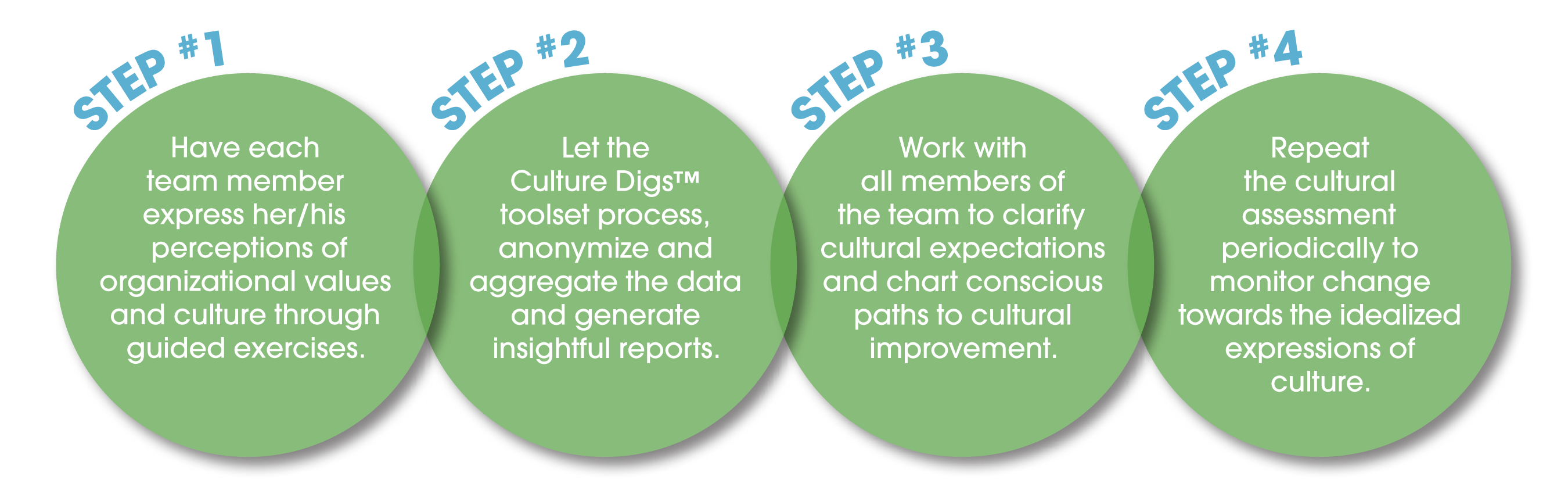
A Culture Digs™ inquiry begins by establishing what the organization wants to understand. Participants then complete one or both of two complementary exercises: exploring the culture they currently experience and describing the culture they would like to help create.
The platform securely collects and organizes those contributions, producing useful outputs that support interpretation. From there, the work can move beyond individual responses toward identifying recurring ideas, tensions and cultural patterns.
This is an important distinction. Culture Digs™ does not assume that a survey response, by itself, defines the culture. Responses are evidence. When examined together, they can support stronger cultural propositions about what people appear to have learned, reveal themes that recur across the organization and identify places where different groups may be experiencing substantially different cultural realities.
The result is a more grounded conversation about culture — one based less on assumption and more on what people have actually reported.
Understanding the culture people experience today is valuable. Understanding what they want instead can add another dimension.
The distance between current and aspirational culture can reveal where people see possibilities for meaningful change. It can expose values that employees would like to experience more consistently, norms they believe need to evolve and aspects of the existing culture they very much want to preserve.
That does not mean every difference becomes a culture-change initiative. Nor should an aspirational exercise become an exercise in inventing attractive words. Its value lies in creating a clearer conversation about what people would need to experience differently for the culture itself to begin teaching something different.
That gives culture change a more practical starting point.
Culture assessment does not change culture by itself. Its first contribution is visibility.
For some organizations, that visibility may confirm important strengths that deserve to be protected. For others, it may expose a gap between the culture leaders believe exists and the culture employees experience. It may reveal competing subcultures, recurring barriers or norms that make an important organizational ambition harder to achieve. The appropriate response depends upon what the evidence reveals.
Guiding Star Communications and Consulting and its authorized partners can support deeper interpretation of Culture Digs™ findings, including assessment and reporting, facilitated conversations, Culture Time workshops and culture-crafting work designed around the organization's particular circumstances.
The objective is not to prescribe a generic culture program. It is to understand the patterns first, decide what deserves attention and then determine what people may need to experience differently if the culture is going to evolve.
Perhaps your organization has articulated strong values, but leaders are unsure whether employees experience them consistently. Perhaps different teams seem to operate according to different unwritten rules, or familiar behaviours keep returning despite previous attempts at culture change.
You may be preparing for growth, restructuring or leadership transition and want to understand what parts of the existing culture should travel forward. Or you may simply sense that something about the way people work together is helping — or hindering — the organization in ways that have never been clearly described.
Culture Digs™ provides a way to investigate those questions without pretending to know the answer before the inquiry begins. Sometimes it confirms what leaders suspected. Sometimes it reveals strengths that were being taken for granted. And sometimes employees describe an organization quite differently from the one its formal statements would suggest.
All three are useful things to know.
The prospect of “changing the culture” can feel enormous. Fortunately, you do not need to begin there.
Begin by understanding it.
Culture Digs™ is available as a secure Software-as-a-Service platform, with pricing based on the number of participants in a wave of assessment. An organization can begin with a focused inquiry, learn what its people are experiencing and decide what — if anything — deserves to happen next.
That makes the first commitment manageable. You are not committing to a sweeping culture transformation before understanding the problem. You are creating the visibility needed to make a more informed choice about whether change is necessary, where it matters and what a realistic next step might be.
Culture is often discussed through broad labels: healthy or unhealthy, strong or weak, positive or toxic. Those descriptions can sometimes point toward a problem, but they rarely tell an organization enough about what is actually happening.
Culture Digs™ goes beneath the label. It gives people an opportunity to describe the values, norms, expectations and stories through which they experience organizational life, while giving leaders a stronger foundation for understanding the patterns those experiences may reveal.
Because before an organization decides how to change its culture, it is worth understanding what people have already learned about how things really work.
When you work with Guiding Star, you ignite real transformation — in your people, your teams, and your impact. Let's spark light, warmth, and lasting excellence for your customers, donors, and stakeholders.
Reach out today. Let's build something brilliant together.
.png)